

Rename conflicts
A rename is safe when every usage still refers to the same declaration afterwards, and nothing else starts referring to
it. Before changing any file, the plugin simulates the new name using the same lookup rules as
name resolution. If the new name would silently break or re-bind code, you see a warning
and can cancel, instead of finding the damage later. For example, renaming state to count in the sample project would make
state <= IDLE assign to the output port count instead.
Try it
Section titled “Try it”The steps use the sample project; open it and wait for indexing first. Cancelling leaves every file unchanged.
-
Open
rtl/counter.svand put the caret (the text cursor) on the second word, the variable namestate(not the typestate_t), instate_t state;. -
Press ⇧F6 (macOS) / Shift+F6 (Windows/Linux), or right-click and choose Refactor | Rename…. Type
countand click Refactor (if the name is edited in place instead, typecountand press Enter).countis already the name of an output port of the module. -
The Conflicts Detected dialog lists two problems:
'count' is already declared in this scope, and what would break as a result,Usage of 'state' in 'state <= IDLE' would refer to another declaration of 'count'.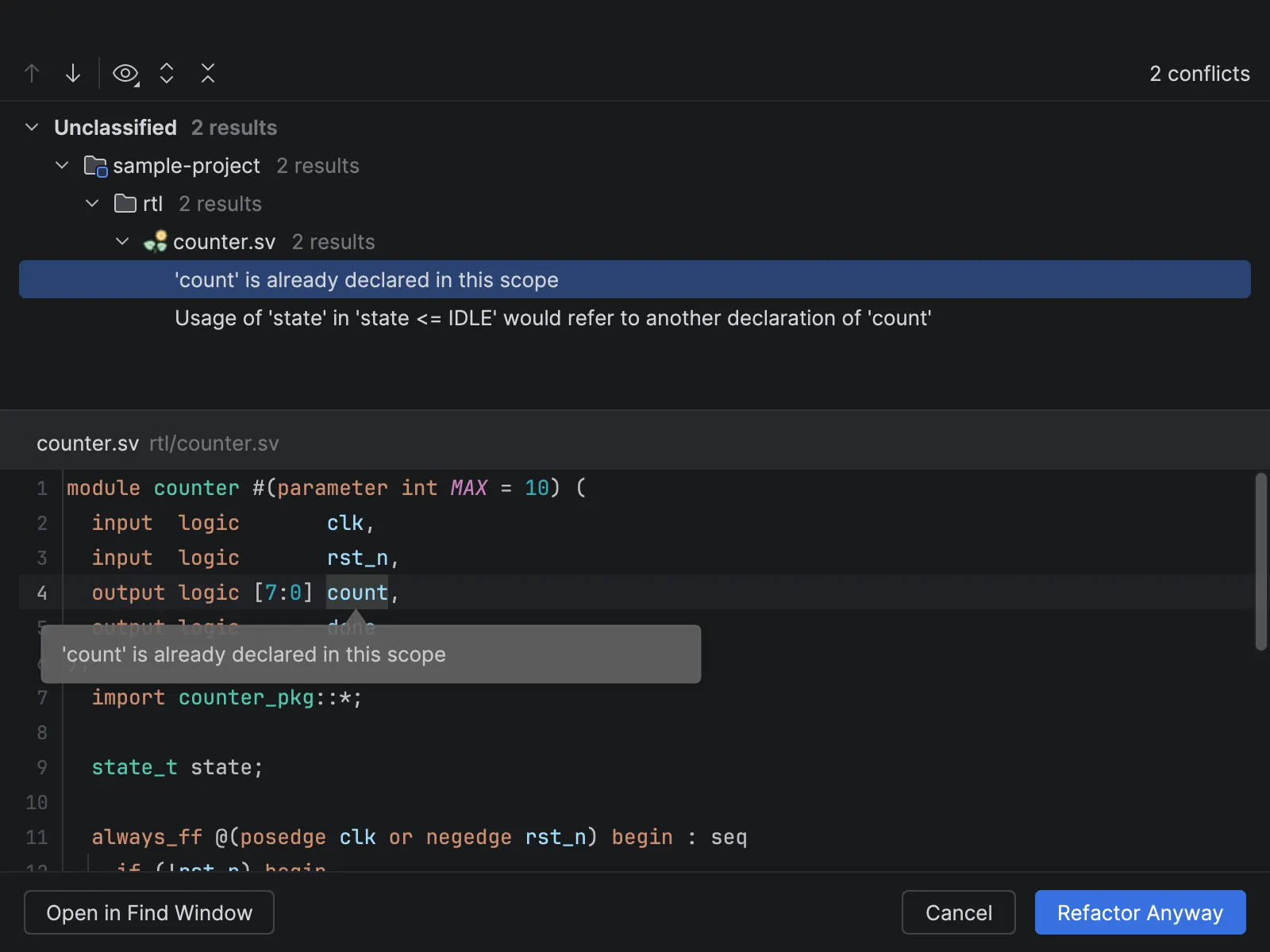
-
Click Cancel. Nothing is changed:
stateis stillstate. (Refactor Anyway would rename it regardless, leaving the code the dialog described.)
If no dialog appears, see If it doesn’t work.
What the dialog does
Section titled “What the dialog does”If the plugin finds problems, the IDE shows the Conflicts Detected dialog listing them. Usually only the first problem of each kind is listed; fixing it may reveal another. Choose Cancel, or Refactor Anyway if you are sure (for example when you are about to fix the other declaration too). The check follows SystemVerilog’s name spaces: a module and a signal, or a package and a variable, may share a name, so renaming a signal to the name of a module is not a conflict.
All the conflicts that are reported
Section titled “All the conflicts that are reported”You do not need to know these cases up front: the dialog’s message names the one that applies.
| Conflict | Example | Message |
|---|---|---|
| Name already declared in the same scope (module, class, block, struct, package, or the project for modules, classes, packages) | rename a to b in a module that declares both; a struct field to another field’s name; module a to b when b.sv declares module b |
'b' is already declared in this scope, 'b' is already declared in this struct, 'b' is already declared in b.sv |
| A usage would refer to something else: an inner declaration with the new name hides the renamed one | rename module signal a to b while block blk declares b and uses a |
Usage of 'a' in 'a = 1;' would refer to another declaration of 'b' |
| An existing name would be captured: code that uses the new name today would start referring to the renamed declaration | rename a declared in block blk to b while the block uses module signal b |
'b' in 'b = 1;' refers to another declaration and would be captured by the renamed 'a' |
Import clash: a package item renamed to a name that an explicit import pkg::item; would bring into a scope that already declares it |
rename p::y to x in a module with import p::y; and logic x; |
'import p::y;' would import 'x' which clashes with the local declaration of 'x' |
| New override: renaming a method to the name of a virtual method of a base class, or so that a subclass method starts overriding it | rename d::g to f where base class base has virtual function void f() |
Renaming to 'f' would override the virtual method 'f' of class base |
| Shared included file: a use in a file included in several places also means another declaration there | rename Width of ram_1p, where memload.svh, included by ram_1p and ram_2p, uses Width |
'Width' in memload.svh also means the declaration in ram_2p.sv (the file is included in several places): renaming changes it there too |
| Macro formal: the new name is a formal of a macro whose body connects the port | rename the port clk_i to clk where `define FLOP(q, clk) prim_flop q (.clk_i(clk)); |
'clk' is a formal of macro FLOP in m.svh: its calls would replace the renamed name |
| New constraint override: renaming a constraint to the name of a base class’s constraint, or so that a subclass constraint starts overriding it | rename d::c_y to c_x where base class base has constraint c_x |
Renaming to 'c_x' would override the constraint 'c_x' of class base |
Wildcard connection: a port or signal connected implicitly by .* would be disconnected or connected differently |
rename port clk of sub instantiated as sub u(.*); |
Port 'clk' is connected implicitly with .* in 'sub u(.*);'; renaming it would disconnect the port |
| Library code: the rename would have to change a file attached as a library | rename build_phase in a class whose base class is in a library file base.sv |
'build_phase' overrides a library method in base.sv which cannot be renamed |
| Duplicate definitions: the same name is also declared in another file and both will be renamed | rename module m defined in a.sv and b.sv |
'm' is also declared in b.sv; usages refer to both, so both declarations will be renamed |
If it doesn’t work
Section titled “If it doesn’t work”| You see | Likely cause | What to do |
|---|---|---|
| No conflict dialog, and the rename just happens | The new name does not clash with anything the plugin can see | Check the result; undo with ⌘Z (Ctrl+Z) |
| A conflict you expect is not reported | The project is still indexing, the file is not in the project or not listed in its compile file (the .f list, such as sim.f in the sample project; see Conditional compilation), or the code is in an inactive `ifdef branch |
See Conditional compilation and Known limitations |
| Rename is not offered | The caret is not on a name, or the name is declared by a macro (such as type_id) |
Put the caret on a declaration; see Macros |
| The shortcut does nothing | Your keymap differs, or on a laptop you must hold Fn | Use Refactor | Rename… |
See also Rename and Troubleshooting.